
Mostrando entradas con la etiqueta Rainforests. Mostrar todas las entradas
Mostrando entradas con la etiqueta Rainforests. Mostrar todas las entradas
jueves, 5 de diciembre de 2013
Looking back on Rainforests!
Who remembers each of the topics we've seen in our Rainforests project?


miércoles, 4 de diciembre de 2013
Recycling Project!
During the last few weeks we've been working with recycling and its importance for saving the planet! We left boxes to recycle plastics and paper in every classroom, and today we went to look for them. A lot of children became comprimised with our project and helped us collect papers and plastics! They will be recycled, thus causing less contamination and helping the planet!!!
Congratulations Fourth Form :)

Congratulations Fourth Form :)

lunes, 2 de diciembre de 2013
What happens to what we recycle?
We can help our planet by recycling! Let's see what happens with the things we have recycled!
Reduce, Reuse, Recycle!

martes, 26 de noviembre de 2013
Different Potions...
A village Medicine Man
Some Fictional Potions!
Harry Potter makes a potion
What ingredients do they use in the videos? Can we find these at home?
martes, 12 de noviembre de 2013
lunes, 11 de noviembre de 2013
Deforestation: impact on Rainforests
What is Deforestation?
Deforestation refers to the cutting, clearing, and removal of rainforest or related ecosystems into less bio-diverse ecosystems such as pasture, cropland, or plantations.What are the causes of deforestation?
I. Logging
II. Mining
III. Oil and gas extraction
IV. Cattle ranching
V. Agriculture: Cash crops
VI. Local, National, and International factors: development, land titles, government subsidies to attract corporations into developing countries, trade agreements, civil wars, debt, lack of resources, and lack of law enforcement.

Deforestation in Borneo.
Largest rainforests worldwide listed in descending order (from largest to smallest).
- Amazon basin of South America
- Congo river basin of Central Africa
- South East Asia
- New Guinea
- Madagascar
- Did you know that tropical rainforests, which cover 6-7% of the earth's surface, contain over half of all the plant and animal species in the world!
- Did you know that 57% of all rainforests remaining are located in the Neotropics, with 30% located in Brazil!
Between 1960 and 1990, most of the deforestation occurred globally, with an increasing trend every decade.
- Brazil has the highest annual rate of deforestation today.
- Atlantic coast of Brazil has lost 90-95% of its rainforest.
- Central America has 50% of its rainforests.
- South America has 70% of its rainforests.
- The Philippines have lost 90% of its rainforests!
- Madagascar has lost 95% of its rainforests!
- El Salvador has lost 70-85% of its rainforest due to heavy bombing during the civil war 1984-1985.
- Sumatra has 15% of its rainforests left.
- Only 6% of Central Africa's forests are protected by law.

Destructive logging in Malaysia.
Statistics on Global Rates of Rainforest Destruction:
2.4 acres (1 hectare) per second: equivalent to two football fields
149 acres (60 hectares) per minute
214,000 acres (86,000 hectares) per day: an area larger than New York City
78 million acres (31 million hectares) per year: an area larger than Poland
On average, 137 species become extinct everyday; or 50,000 each year!
*If the current rate of deforestation continues, the world's rain forests will vanish within 100 years- causing unknown effects on global climate and eliminating the majority of plant and animal species on the planet*

Small-scale deforestation in the Amazon.
What are the consequences of deforestation?
Environmental:
- Extinctions (loss of biodiversity of microbes (bacteria), plants, insects, animals, indigenous peoples, etc.
- Habitat fragmentation. This disturbs the animals' habitat and may force them to enter habitats which are already occupied. This can pose many problems such as territorial conflicts, homelessness (loss of habitat), lack of food availability, migration disturbances, etc.
- Soil erosion occurs when trees and plants are removed; the rain water washes the nutrients in the top soil away.
- Changes in watershed geomorphology.
- Desertification (dry, hot, arid conditions).
- Edge effects can change microclimates (small climates) which affect endemic species (native species which can only live in specific environmental and habitat conditions).
- Climate change (more carbon dioxide is released into the atmosphere, thus increasing the effects of global warming).
- Pollution (ground, water and air pollution from oil extraction and mining chemicals).

Deforestation for palm oil production in Borneo.
Social impacts:
- Loss of culture (indigenous peoples subsistence living in the rainforest). People who live in the rainforest depend on the natural environment for food, shelter, materials for cooking, clothing, etc. If the forest is cut down or if their environment becomes polluted from oil extraction and mining, they are forced to move or risk starvation and sickness.
- Displacement of people (loss of farmland, forest resources, etc).
- Social conflicts and struggles over land and natural resources.
- Conflicts over racial and ethnic rights.
- Poisoning from oil and mining waste.
- Economic uncertainty (price fluctuations and high interest rates on outstanding international loans with The World Bank and International Monetary Fund.

Oil Palm Estate and Rainforest in Malaysian Borneo.
What can we do to STOP or at least lessen the amount of deforestation and conserve our own use of natural resources such as wood, oil and gas, electricity, minerals and elements, and water? Brainstorm...here's a start:
- Always use both sides of paper when writing, drawing, photo-copying, faxing, etc.
- Recycle paper, cans, glass, and plastic.
- Read the newspaper on-line.
- Buy paper products made from recycled paper: notebook paper, paper towels, toilet paper, books, etc.
- Use pencils until they are stubs! Think of pencils as gold (you'll never lose them if you do).
- Encourage your parents, relatives, and friends to buy furniture and wood that is Certified. That means the wood was legally cut-down.
- If you buy a product and you notice they use wood chips to package it, write to the company and suggest they use another packaging material.
- Trees get cut down for cattle to graze. Instead of eating meat, think of eating other sources of protein such as fish, soy, beans, whole-wheat, and nuts.
- Buy organic fruits and vegetables. That means there are no insecticides or pesticides (poisonous chemicals) sprayed on the food. If these chemicals kill insects and pests that try and eat the vegetables, think about how harmful they can be to you and the environment.
- Instead of buying gold or diamonds, which are mined and cause environmental damage, consider jewelry that is made from materials that are not mined...such as glass.
- Encourage your parents, relatives, and friends to drive fuel efficient cars that get good gas mileage. Hybrid and bio-diesel cars get great mileage and use less or no gasoline.
- Even better, whenever possible, walk, bike, carpool or use mass transit (bus or train).
- Save electricity by turning off lights, t.v., radio, computer, etc when you are not using them.
- Save water by NOT taking baths; instead take quick showers (turning off the water while you soap up) and then turning it back on to rinse quickly.
- While washing your hands and brushing your teeth, turn off the water. You'll save gallons if you do.
- When washing the dishes or your parent's car, turn off the water while washing it with soap. Rinse quickly after washing.
- Hmmm, can you think of other ways to conserve wood, oil and gas, electricity, minerals and elements, and water, etc...?

Deforestation in Malaysian Borneo.

Gold mining.

Gold mining.
miércoles, 6 de noviembre de 2013
Rainforest medicine
Medicinal plants in a rainforest
The Shaman or Medicine Man
The Shaman or Medicine Man
"Medicine man" song by Bobby McFerrin!
martes, 5 de noviembre de 2013
Maori Haka
The Haka is a traditional war chant, dance or challenge from the Maori people of New Zealand. It is a posture dance performed by a group, with vigorous movements and stamping of the feet with rythmically shouted accompaniment.
They can be performed for many reasons: for amusement (fun), as a welcome to a guest, or to acknowledge great achievements, occasions or funerals
The New Zealand rugby team, the All Blacks, perform a haka before their matches.
Maori Haka
lunes, 4 de noviembre de 2013
People of the rainforest
PEOPLE OF THE RAINFOREST
| We often overlook the millions of people that live in the rain forests. Did you know that there are about 50,000,000 tribal people living in world's rainforests? These people depend on the forests for their food and shelter. As we cut more and more trees and destroy more and more of the forests, we are also killing people. Many native tribes have been exterminated already because their governments failed to protect them from logging companies, the mining companies and the slash and burn farmers. Here is some more information about three of the larger and more well-known tribes: | |
 | The Pygmies This Pygmy woman is food outside her hut, with her baby cradled on her back. Mbuti and Baka Pygmies live in the rainforests of Central Africa. Traditionally they live by hunting and gathering food. |
 | The Huli The Huli are one of the many tribes that live in the remote highland forests of Papua New Guniea. They live by hunting, gathering plants and growing crops. Men and women live seperately, in large group houses. The men decorate their bodies with colored clay and wear elaborate headdresses for ceremonies. |
 | The Yanomami One of the largest groups of Amerindian people in South America is the Yanomami. Their village life is centered around the yano, or communal house. The yano is a large, circular building constructed of vine and leaf thatch, which has a living space in the middle. This picture shows Yanomami men eating a meal. |
Why are rainforests important?
WHY ARE RAINFORESTS IMPORTANT?
Rainforests are important to the global ecosystem. Rainforests: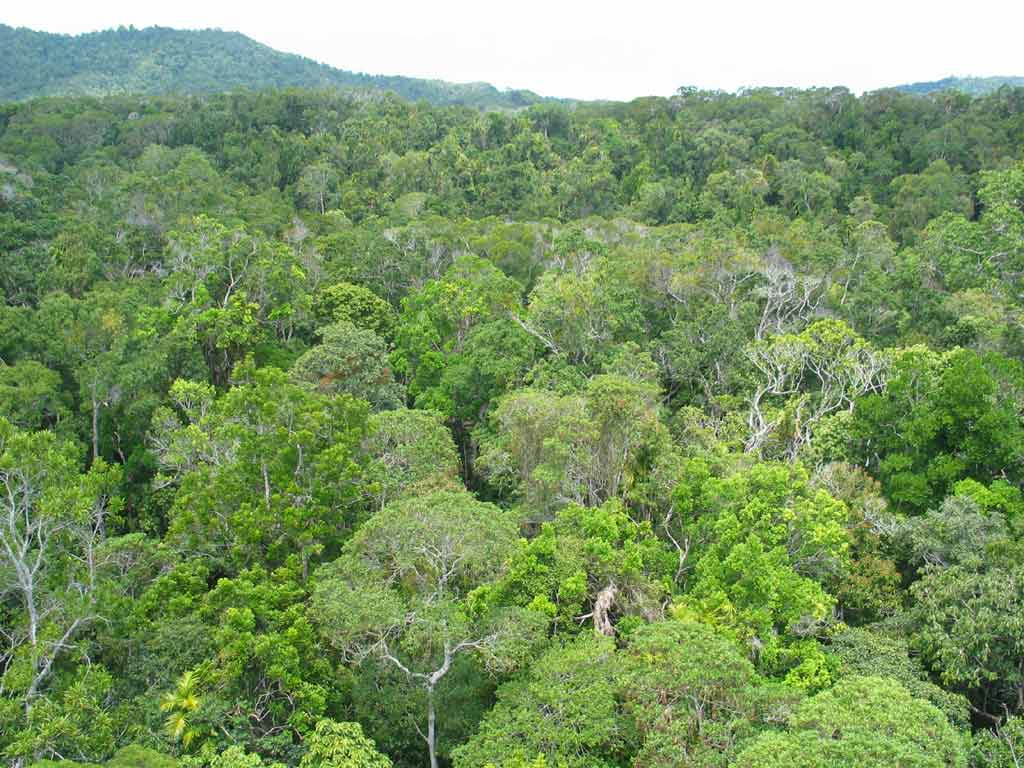
- provide a home to many plants and animals;
- help stabilize the world's climate;
- protect against flood, drought, and erosion;
- are a source for medicines and foods;
- support tribal people; and
- are an interesting, beautiful place to visit
The air we breathe comes from trees, and most of the World's trees live in Rainforests!
Rainforests help stabilize the world’s climate by absorbing carbon dioxide from the atmosphere. Excess carbon dioxide in the atmosphere is believed to contribute to climate change through global warming. Therefore rainforests have an important role in addressing global warming.
Rainforests also affect local weather conditions by creating rainfall and moderating temperatures.
Rainforests are home to a large number of the world’s plant and animals species, including many endangered species. As forests are cut down, many species are doomed to extinction. Some rainforest species can only survive in their natural habitat. Zoos cannot save all animals.
miércoles, 30 de octubre de 2013
Rainforest Birds
Birds of the Rainforest... Do you know them?
Exotic birds from the Amazon Rainforest...
martes, 29 de octubre de 2013
Top Ten Most Dangerous Animals!
Top ten most dangerous animals in the rainforest
Rainforest Food Web:
Which is the most important animal in the rainforest?
Rainforest Games!
Hello! Here are some games to continue learning about Rainforests. Enjoy and have fun!!!
The Rainforest Rangers
http://playrific.com/images/media/link_53_-_diego_rain_forest.png
The Rainforest Rangers
lunes, 28 de octubre de 2013
Why are Rainforests important?
Rainforests:
- help stabilize the world’s climate;
- provide a home to many plants and animals;
- maintain the water cycle
- protect against flood, drought, and erosion;
- are a source for medicines and foods;
- support tribal people; and
- are an interesting place to visit!
jueves, 24 de octubre de 2013
Rainforests Project: What is a Rainforest?
What is a Rainforest?
A rainforest is a hot, thick jungle that gets a lot of rain. A large number of plants and animals live there.
Most rainforests are located around the middle of the Earth, near the Equator. They help to clean the air that we breathe!
And here is another video of the amazing tropical rainforest!
miércoles, 23 de octubre de 2013


Suscribirse a:
Entradas (Atom)